Periodic Constitutional Convention Referendums: History, Politics, and the Case for Reform

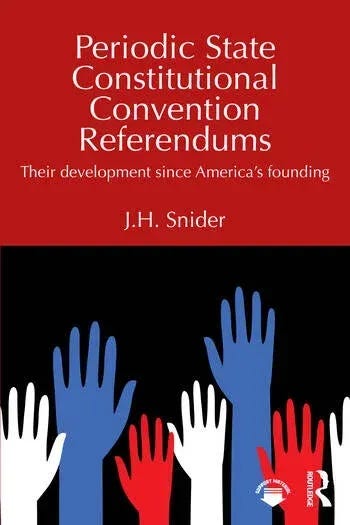
On May 6, Routledge published my book, Periodic State Constitutional Convention Referendums: Their Development Since America’s Founding. This article summarizes its content. It introduces the institution of the Periodic Constitutional Convention Referendum (PCCR) and then outlines its history, contemporary politics, and need for reform. This is a revised version of an article published in The Election Law Blog’s Book Corner in a four-part series that ran daily from May 11 to 14, 2026.
How does one address systemic democratic dysfunction at the U.S. state level? Until the early 20th Century, the primary mechanism was the state constitutional convention. The PCCR, a variant of this institution, was invented to enable the people to initiate a convention independently of the state legislature.
Fourteen U.S. state constitutions, representing 88 million Americans (approximately one-fourth of the population), include the PCCR as a mechanism for initiating constitutional change. The PCCR includes three public votes that bypass a state’s legislature: 1) whether to call a constitutional convention, 2) if called, who to vote for as convention delegates, and 3) whether to ratify the amendments proposed by the delegates.
Each of the three public votes that bypass the legislature has a distinct democratic function. The first vote initiates constitutional change. The second elects delegates who then propose one or more constitutional changes. And the third vote ratifies those proposed changes. The constitutional convention, as it was invented in Massachusetts in the late 1770s, includes the second and third public votes, but not the first.
In terms of democratic theory, these votes are a type of constituent power, the people’s sovereign power to make a constitution, with the first public vote illustrating “constituent initiation power,” the second “constituent proposal power,” and the third “constituent ratification power.” The combination of constituent initiation and proposal power comprises “constituent agenda-setting power.”
The offices created by a constitution are the “constituted powers,” and it is a staple of “constituent power theory” that constituted powers have a conflict of interest in designing their own powers and those of competing branches of government. Consequently, a major function of a written constitution, including its change mechanism, is to constrain the power of the constituted powers.
Given this conflict of interest, a democratically legitimate constitutional change mechanism requires that the constituent power not be dependent on the constituted powers; for example, that no legislative proposal be allowed to become law without first being directly ratified by the people or that, as with the constitutional convention, the people must be able to not only ratify but propose changes independently of the legislature.
Accordingly, all 50 U.S. states require constituent ratification power: the people must approve any constitutional changes proposed by a legislature or constitutional convention. All 50 states also provide constituent proposal power, allowing a legislature to initiate a constitutional convention. However, only some states provide constituent initiation power, allowing the people to initiate constitutional change through either the PCCR or a constitutional initiative.
Agenda-setting power, especially initiation power, is more causally remote to constitution-making than the power to ratify, which helps explain why it is so often overlooked among constitution-making mechanisms. But that does not make it unimportant. It is the power to initiate constitutional change independently of a legislature that the PCCR in the late 18th Century introduced into the U.S. state system of constitutional change mechanisms.
The PCCR’s automatic placement of a constitutional convention call referendum on the ballot at a fixed interval takes the choice of whether to place the referendum on the ballot out of the legislature’s hands and grants it to the people, thus creating constituent initiation power. The periods between referendums to call a convention range from 10 to 20 years, with 20 years for eight states, 10 years for five states, and 16 years for one state. During the next four years, seven PCCRs will be on the ballot: Michigan (2026), Connecticut (2028), Hawaii (2028), Illinois (2028), Iowa (2030), Maryland (2030), and Montana (2030).
The constitutional initiative, the other major mechanism for implementing constituent initiation power, is specified in 18 state constitutions. In total, 24 states, covering 145 million people (about 65% more than for the PCCR), provide for some type of ballot initiative. Compared to the ballot initiative, the PCCR offers more opportunities for publicly financed democratic deliberation at the constituent agenda-setting stages of constitution-making. This is another way of saying that once a convention is launched, the proposal power of well-organized and well-financed interest groups is much diminished compared with that of the ballot initiative, since any delegate can propose a reform simply by raising her hand.
Both the PCCR and the ballot initiative were at least partly designed to facilitate the proposal of popular fixes to systemic democratic dysfunction that legislatures weren’t addressing. An example of such a dysfunction that has been much in the recent news is legislative gerrymandering, which is highly unpopular yet resistant to legislatures fixing it on their own.
No scholarly consensus exists on how many state constitutional conventions America has held over the last 250 years, partly because there is disagreement over how to define a convention. For example, many early conventions lacked ratification votes. Some, such as Louisiana’s 1992 “constitutional convention,” even lacked independently elected delegates. The most widely used numbers in the literature range from 233 to 256 state conventions—an average of about five per state. All fourteen PCCR states limit a convention to proposal power (that is, the people must ratify any proposals it makes before the proposals can become law), and thirteen of the fourteen states mandate an independently elected convention (in the fourteenth, it is optional). In terms of past conventions with a reasonable degree of constituent proposal and ratification power, I suggest that no more than 157 should meet that threshold.
Contemporary state legislatures disparage the constitutional convention process. They are fiercely opposed to calling conventions because such conventions reduce their gatekeeping power over constitutional change. An important exception to this opposition is statehood and territorial conventions, such as the one currently meeting in the U.S. Virgin Islands, which transfer control over fundamental law from the U.S. Congress to a U.S. subnational legislature. Traditionally, Congress has mandated that a subnational unit seeking its own constitution must convene a convention. This explains why, in 2020, USVI’s legislature approved placing a convention call referendum on the ballot and, in 2024, held an election for convention delegates. In 2027, USVI citizens will vote on whether to approve the resulting convention’s constitution, thus potentially shifting control of USVI’s organic law from Congress to USVI’s legislature.
Just as law can be divided between lower and higher types, so can representative elections. Representative elections for constituted powers, such as for the legislative, executive, and judicial branches, are governed by lower election law. Elections for constitutional convention delegates are governed by higher election law. Each of the three types of public PCCR votes should be a distinct area of higher election law. Higher election law regarding conventions is notable for court rulings and election administration that are inconsistent and politicized, partly due to a lack of scholarly and media attention.
“Snider’s book is a rigorous, unsettling account of how the periodic constitutional convention referendum went from democratic cornerstone to democratic orphan, and what it would take to restore it. “
--Andy Moore, Executive Director, National Association of Nonpartisan Reformers
PCCR’s History
The PCCR is both old and new. The first state to adopt it was New Hampshire in 1792. But of the fourteen states that presently have it, only six had it by the end of the 19th Century, so it is largely a 20th Century phenomenon. During the 20th Century, three states (Oklahoma, Hawaii, and Alaska) got it when they became states; four states (Connecticut, Illinois, Montana, and Rhode Island) in the aftermath of the 1960s reapportionment revolution, a series of U.S. Supreme Court cases that forced the reapportionment of state legislatures based on one-person, one-vote and led to the last major wave of U.S. state constitutional conventions. One (Missouri) got it via the ballot initiative. All fourteen states got PCCR independently of the legislature—thirteen via a convention; the fourteenth via a ballot initiative.
Many people equate the constitutional convention with revising an entire constitution. While conventions can do that—and it is demanded of a statehood convention—it is not a universal practice. For example, New Hampshire has both the second-oldest constitution in the world and the record for convening the most conventions—ten alone during the 20th Century. All those conventions, some 16 or 17, depending on how one defines a convention, only proposed amendments to the original Constitution.
Many scholars consider the constitutional convention the gold standard of mechanisms for constitutional change, but conventions are also expensive. Before the 20th Century, convention and legislative proposal of constitutional change were often viewed as complements rather than substitutes. That is, sometimes a Toyota Corolla is better than a Toyota Lexus because it is more affordable. Legislatures were best for proposing simple amendments; that is, when legislatures could be trusted and spending more on a convention would be wasteful. Conventions were best for handling the more difficult tasks of safeguarding and enhancing democracy. Today, in contrast, these two mechanisms of change are widely viewed as substitutes.
There were no grand democratic theorists of the PCCR. It primarily grew organically as the early U.S. states adopted written constitutions and, as a secondary concern, sought to devise ways to amend them—without resorting to revolution—at the initiation, proposal, and ratification stages of constitution-making. All the basic legislative-bypass ideas for creating a written constitution were in place by the late 1770s, when the people of Massachusetts demanded an independently elected constitutional convention combined with popular ratification of its proposals. It is remarkable that a democratic reform idea that seemed so obvious to Massachusetts farmers with minimal education seems so foreign to today’s highly educated Americans, including those with degrees in political science and law.
Some Massachusetts towns that commented on the resulting constitutional convention’s proposed constitution extended this line of reasoning to support the PCCR. But only neighboring New Hampshire would fully implement this idea more than a decade later. The idea did not initially scale well, partly because referendums in Massachusetts and New Hampshire were done via town meetings—an option generally unavailable outside New England.
Not until New York adopted the PCCR in 1846, which led to the first great wave of PCCR adoption between 1846 and 1857, did the PCCR become a legislative bypass institution in the modern sense. That is when the PCCR was, for the first time, included in a constitution that also enabled the legislature to propose constitutional changes. New York in the 1840s also appears to provide the most eloquent early public record of arguments endorsing the PCCR as a legislative bypass mechanism.
Jean-Jacques Rousseau’s democratic theory has much in common with the PCCR. Rousseau advocated lawmaking assemblies that would convene periodically, so their existence would not depend on the king’s support. But Rousseau’s assemblies also differed from the PCCR in significant ways. They could propose both lower and higher law, rather than just higher law. Their periodic convening was to check a king, not a legislature. And the period was to convene an assembly rather than merely create an opportunity for the people to call one.
Thomas Jefferson is the American most often credited as the champion of the PCCR. Indeed, the 20-year period widely used for PCCR can be traced back to Jefferson’s theory that every new generation should have the opportunity to rewrite its constitution. But nothing in Jefferson’s theory precludes a legislature from initiating constitutional change when change is needed. Jefferson primarily conceived constituent-initiation power in terms of a Lockean right of revolution (famously espoused in his Declaration of Independence) rather than through the PCCR’s non-revolutionary mechanism.
A key insight is that the constitutional convention’s democratic function and politics depend on its constitutional context. When it is the only constitutional change mechanism available in a constitution, as was often the case until the mid-19th century and as late as 1964 in New Hampshire, it is as much a mere updating mechanism as a legislative bypass one; opposition from the legislature and special interests to it is also reduced.
“Conventions were once called on a regular basis to revise the constitutions of the 50 states and enact significant governmental reforms. In this excellent book, J.H. Snider, the foremost expert on the topic, focuses on the automatic periodic constitutional convention referendum – tracing the origin and development of this institution, demonstrating its benefits and recommending some improvements, and also analyzing and drawing lessons from several recent referendum campaigns.”
--John Dinan, author of The American State Constitutional Tradition
PCCR’s Contemporary Politics
To understand the PCCR’s contemporary dismal politics, one must first understand the incentives of its various political actors. Here, it is undesirable to rely on the various actors’ self-descriptions because seeking power is generally not a socially acceptable motivation. Instead, one must rely on rational choice theory, supplemented by studies of actual behavior.
The Legislature. Legislatures are natural enemies of the PCCR and of the state constitutional convention process more generally because legislatures want to preserve their gatekeeping power over constitutional change. Exceptions to this rule include cases in which external forces pressure subnational governments to call a convention. These include statehood conventions and the aftermath of the Civil War in the late 1860s, when Congress required Southern states to revise their constitutions through independently elected conventions as a condition to rejoin the Union.
Apex Interest Groups. Apex interest groups are defined as those that excel at influencing legislatures and are thus also natural enemies of the constitutional convention process. Such groups may be associated with the left or right and include labor and business groups. The specific reasons for their enmity include: First, their investments in legislative relationships are devalued if a convention is called. Second, conventions cannot pass unpopular legislation at the last minute and without public scrutiny; conventions can only propose laws, which must then be publicized and ratified by a majority of the people. Third, unlike legislators, they have minimal means to punish wayward delegates because delegates are not up for re-election; convention accountability largely comes from the ratification vote that follows the convention’s proposals. Fourth, partly because delegates, unlike legislators, do not stand for re-election, and their actions are likely to be scrutinized more carefully by future courts and historians, they tend to be more focused on creating a positive legacy.
Secondary interest groups. Secondary interest groups that need support from the above interests to be politically effective will not find it in their self-interest to support a constitutional convention, especially if convening one is not central to their mission, which it rarely, if ever, is. The rational position for a group that depends on coalition support to win on its core issues is either to take no position or to oppose calling a convention. These political incentives were considerably weaker in the past. One reason is the increasingly widespread perception that calling a convention has become a quixotic undertaking, so it is not worth alienating political allies. In the 21st Century, popular secondary interest groups that depend on support from unpopular apex interest groups for their success have often served as the public-facing opposition to the PCCR.
Throughout much of American history, countervailing incentives mitigated the effects of the above incentives. The long-term trends changing those incentives include the advent of competing constitutional change mechanisms, the increase in career-oriented legislators, the growth of government and the corresponding powerful interest groups it generates, and growing mistrust among Americans of their fellow Americans, partly as a result of growing identity politics, where Americans see themselves as part of minority groups.
A consequence of these political incentives is that political and interest-group elites on both the left and the right are overwhelmingly opposed to calling a state constitutional convention. And since the most educated members of the public take their political cues from these elites, they, too, are opposed to calling a convention, often developing an instinctive repugnance toward anyone calling for one.
My book focuses on three case studies to describe three aspects of the PCCR’s dismal contemporary politics.
Case Study #1: PCCR’s Institutional Foundations. The Maryland case study examines how legislatures can undermine the PCCR as an institution. An analogy is the many ways legislatures have sought to undermine the ballot initiative. Among their dozens of techniques for doing this are increasing signature requirements, raising thresholds for approving the resulting ballot initiative, and biasing ballot text. In Maryland, the technique was for the legislature to exploit a vaguely worded majority denominator to call a constitutional convention. The result was that the denominator became so large that calling a convention became nearly impossible. The legislature also relied on the state’s courts to treat its interpretation as a political question—not for the court to decide.
Case Study #2 : PCCR’s Campaign Finance. The Alaska case study focuses on campaign finance. In 2022, Alaska’s constitutional convention referendum call was the most expensive ballot referendum among the 140 ballot referendums on the ballot that year in the entire U.S., as measured on a per capita basis for a 1) “no” campaign, and 2) a dark money campaign. “No” money outspent “yes” money by almost 80:1. Alaska illustrates how the “no” interests that fund such campaigns have the means and incentive to spend whatever it takes to both win and deter future “yes” campaigns. A reputation for invisibility in PCCR politics is highly valuable because referendums to call conventions are nearly identical across all fourteen PCCR states and occur indefinitely, with perfect predictability.
Case Study #3: PCCR’s Campaign Messaging. The Rhode Island case study focuses on messaging strategies. Rhode Island is a good case study for messaging, partly because of its active “yes” and “no” campaigns in 2004, 2014, and 2024. Rhode Island was the last state in the U.S. to both pass a PCCR provision and call a convention via the PCCR. Rhode Island adopted the PCCR in 1973 and held a convention under the PCCR in 1984. As in Alaska, “no” resources dwarfed “yes” resources, including both organizational and financial resources. And these resources were used to claim that a convention would be dominated by unspecified “wealthy, special interests” and offer no benefits over the mechanism of legislative constitutional proposal, while incurring high costs and being intolerably risky to the rights that Rhode Islanders cherish. “Yes” advocacy was uncoordinated, lacked access to advertising, and relied on free media to promote a hodgepodge of reforms, such as universal access to education and an independent inspector general, that the legislature had failed to pass.
The difference between the incentives and the stated reasons for opposing state constitutional conventions gives convention politics a remarkably Machiavellian structure. This is vividly illustrated by conflicting arguments used with different audiences; for example, the argument that a convention will harm Democrats to Democrats and harm Republicans to Republicans. This type of Machiavellian politics thrives in the contemporary information environment, characterized by abysmal PCCR civic education, including public ignorance of its function, history, and politics.
“J. H. Snider has written a truly illuminating book about the most important single political idea of the last 400 years--popular sovereignty, This is a first-rate book in applied political theory that makes very clear the importance of truly popular conventions to the realization of genuine democracy. Political scientists will find especially interesting (and quite dismaying) the carefully developed case studies of several states that elaborate on the hurdles placed in the way of reviving an important aspect of America’s constitutional order. The book is especially timely as we consider the full implications of the Declaration and of Independence 250 years ago.”
--Sanford Levinson, University of Texas Law School and author of
Framed: America’s 51 Constitutions and the Crisis of Governance
Recommendations
The U.S. Declaration of Independence is widely viewed as encapsulating the principles that define what it means to be an American. As part of this year’s 250th anniversary of the Declaration, more attention should be given to a clause in the Declaration that has been routinely ignored. The clause states that the people have an unalienable right to alter their form of government (i.e., their constitution). That is, the people have a right to constituent power. Consequently, a constitution that does not grant the people meaningful constituent power lacks legitimacy as a democratic constitution. Most state constitutions have a similar clause.
Constituent power is the most fundamental of all political rights—more fundamental even than the generic right to vote—because a constitution is the source of the other fundamental rights. It is remarkable that this year of America’s 250th anniversary, government officials are spending hundreds of millions of dollars to educate the public about the Declaration’s core principles—the key ideas that make Americans American—without any meaningful discussion of constituent power.
On June 8, 1789, James Madison proposed an amendment to the U.S. Constitution (the first amendment in the package that later became the Bill of Rights) that included language on constituent power like that in the Declaration above. A version of the amendment passed the House Select Committee but was defeated in the Senate. Madison’s proposed amendment should be reintroduced. However, instead of its vague language about the scope of constituent power, the text should state that constituent power encompasses not only ratification but also agenda-setting power independent of constituted powers. A primary goal of this amendment would be civic education, as reading and discussing the U.S. Constitution is a staple of it.
Meaningful constituent power is not only a foundational principle of U.S. state constitutions and one whose implementation has significantly evolved over the past 250 years; it should continue to evolve.
Institutions of higher democracy need democratic reform just as lower-level democratic institutions do. But the democratic reform community has been overwhelmingly focused on reforming the processes of lower democracy, thus facilitating the decay of the processes of higher democracy. Legislature bypass mechanisms, including the PCCR, need repair and improvement.
For example, delegate elections could be revamped to include open primaries, multi-party label (fusion) voting, and ranked-choice voting. Citizens’ assemblies could serve as arbitrators in disputes between a legislature and a constitutional convention over funding, staffing, and other issues related to convention-enabling acts. They could also be used to listen to debates on convention proposals, with opposing sides selected by the convention and legislative leadership. Then, the Citizens’ assembly could vote on convention proposals, with those votes included on ballots as an informational shortcut for voters, just like party labels are used as an informational shortcut on ballots.
Given the hostility of legislatures and America’s most powerful interest groups to calling a genuine constitutional convention, the PCCR may be the last politically viable means in America for an existing state to call a reasonably genuine convention.
The concept of the “constitutional convention” should be reconceptualized as an ordinal rather than categorical variable, with conventions categorized by their degree of constituent power. The democratic attributes of conventions should be ranked by the extent to which they incorporate meaningful constituent power to initiate, propose, and ratify. For example, if a convention’s delegates are forced to comply with a legislature’s agenda or consist only of legislators, it should receive no credit for constituent proposal power. For conventions that meet a high standard of constituent power, I would label them as “constituent conventions.” For pseudo-conventions, such as Washington, DC’s 2016 constitutional commission that often masqueraded publicly as a “constitutional convention,” attempts to label them as any type of convention should be criticized.
Election law textbooks should acknowledge higher election law as an important, distinct field within the study of state elections. Sub-fields should include convention call referendums, delegate elections, and ratification referendums. Just as ballot initiatives are recognized to have distinct campaign finance, election administration, and case law issues, the same should be true with the PCCR and conventions more generally.
Populism, defined as lip service to democratic values without implementing truly democratic processes, occupies two tracks in a constitutional democracy: one lower and one higher. It is often the case that the same individual who denounces lower-level populism is a fervent higher-level populist, albeit benightedly. Such a pseudo-commitment to democracy should be opposed regardless of the democracy track in which it occurs. Meaningful popular rule requires rigorous, well-defined procedures to implement it. If a political actor respects the public so little that it refuses to grant it meaningful constituent power, then that actor’s claimed commitment to democratic constitutionalism should be questioned. For example, if a political actor believes that the people, by their nature, will be so influenced by special interests that they cannot be trusted to ratify proposals for constitutional change, then that should be viewed as an attack on democratic constitutionalism.
The public should be taught that meaningful constituent power is essential to the long-term preservation of constitutional democracy and democracy more generally. To the extent that this is so, America’s civic institutions, including K-12 schools, colleges, museums, and public celebrations such as America’s 250th anniversary, should receive failing grades. My next book addresses this subject in more depth.
#
Scan the QR code to order the book or visit
https://www.routledge.com/9781041022596